Intersect weekly update #134 Oct 24, 2026
Welcome to Intersect’s update #134, "Receipts"
The public Dijkstra testnet opened on Tuesday. If you run a pool or build tooling, the readiness work is now something you can log into rather than a date in a plan, and IOG has published a proper account of how Leios gets from there to mainnet.
The rest of the week is about things you can check. 115,172 ada of unspent budget went back to the treasury, the first time that has happened on mainnet. A new portal publishes Cardano's decentralization figures with their methodology attached. CAP-12 and CAP-3 both reached a fourth draft, with every change traceable to the comment that prompted it. And we would like two minutes of your time to tell us what the treasury dashboard is missing.
Contributors: Ian H, Larisa M, Thomas L, Duncan S, Intersect
 Latest on Cardano upgrades
Public Dijkstra testnet is here!
A respin of the Dijkstra testnet took place on October 21 and is now publicly available for all participants. It is currently running protocol version 11 (Conway) on node version 11.1.3. Once the pre-release of node version 11.2 is available, a hard fork initiation action will be submitted to move to protocol version 12 (Dijkstra). In the meantime, SPOs can now begin onboarding to the network using the config files available on Cardano book, which also hosts the link to the Dijkstra testnet faucet. Epochs are one-day in length and a Kleioscan explorer is also available. Happy testing!
Leios
IOG published a fresh and detailed account of how Leios gets from here to mainnet. Worth a read to really understand Leios, particularly in explaining an assumption held by many: the hard fork doesn’t switch Leios on at full capacity, but it does make the protocol available, and the rollout happens in stages after it.
There are five steps. First, the Constitution has to name the new Dijkstra parameters and set the safe range for each. “Guardrails” can sound like a restriction, but here it's the opposite: a parameter with no Constitution entry can’t be changed by governance later.
So without this step, the Leios throughput settings would be stuck at their launch values.
The hard fork moves Cardano onto the new rules. SPOs then register BLS keys, and Leios begins operating once enough stake has registered. Mainnet load exercises measure how endorser blocks and votes actually travel across a live network of around 2,700 pools. Then at least two parameter updates raise throughput, each backed by what the previous step showed.
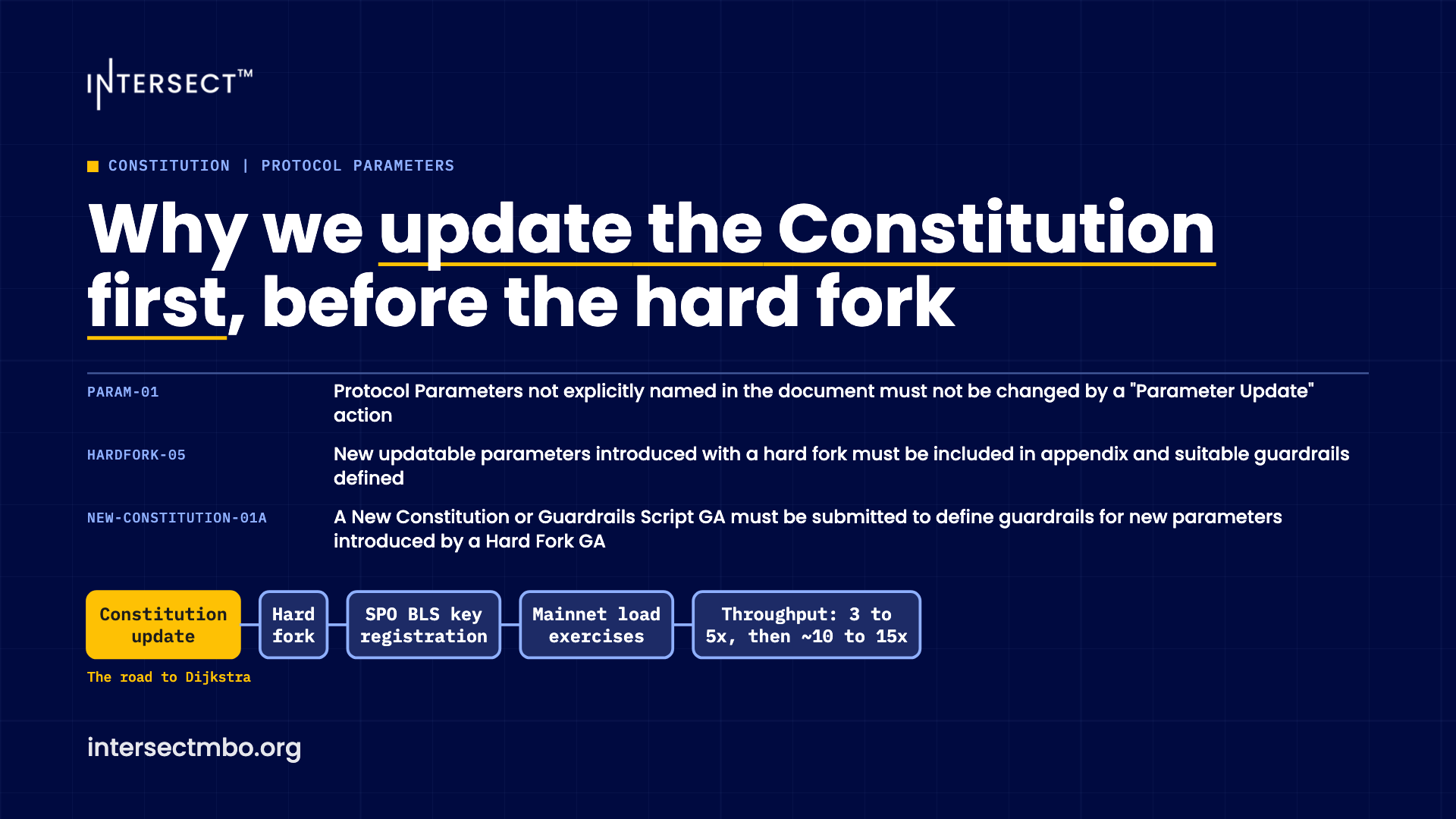
Leios starts at roughly 3 to 5 times today’s Praos ceiling of 4.5 TxkB/s, with later updates targeting 10 to 15 times. Those increases need no further hard fork, only parameter updates inside the ratified guardrails. This is why CAP-12 matters so much, and why it's worth reading now rather than later. More on this in the next section.
For SPOs the practical ask remains to be ready to run a Dijkstra-ready node, vote in the hard fork action, and register a BLS key after the upgrade. Registration needs to reach roughly 90 to 95% of delegated stake, around the top 500 to 900 pools, because a Leios certificate needs votes representing 75% of all active stake and some pools will always be slow or offline. Pools without a BLS key keep producing Praos blocks, but cannot vote on endorser blocks.
Node diversity workshop
Preparations continue for the Node Diversity Workshop in London on November 12–13, organized by the Amaru team. The venue has been confirmed as the London Marriott Hotel Canary Wharf. The agenda includes examining future hard fork features from both implementation-cost and community-needs perspectives, helping inform how future upgrades are scoped and prioritized across an increasingly diverse node ecosystem. For those wishing to attend, invitations remain open until November 5, if you want to add people to the event please email the organizer Damien.

Constitutional Amendment Portal (CAP) updates
Both CAP-12 and CAP-3 moved to a fourth version this week, and in both cases the comments did most of the work.
CAP-12, the Dijkstra era parameters.
Last week we said the next revision was awaited. It arrived, with a second TSC round in between. On Oct 19, the TSC chair posted seven comments on behalf of the Parameter Committee: backing the community suggestion that the Leios off switch be described as an orderly deactivation rather than an emergency one, supporting a written fast path for genuine Severity 1 or 2 incidents, passing on the committee’s recommendation to split the Peras parameters into their own amendment, and withdrawing his earlier proposal to cap how far the pledge leverage parameter can move in one step in favour of a limit on how often it can change.
Two days later the author posted version four, which takes nearly all of it on board. The claim that the proposal changes nothing existing is gone, replaced by an honest list of the five provisions it does change. The old minimum pool cost guardrail has real replacement wording. Peras is out.
The renamed reference-script guardrails follow the Constitution’s labelling convention, a consistency pass has aligned the whole draft with the ratified Appendix, and the parameter specification it links to is finally public. The editor review found one slip to fix straight away: the new fast-path guardrail landed on the wrong parameter, a copy error that matters because the Guardrails Script team reads those IDs literally.
Still open are the pledge leverage range, the placeholder numbers, a short description of what the off switch is and how it relates to what operators can already do, and whether CIP-23 ships in the first or second phase of Dijkstra.
CAP-3, the Net Change Limit as a strategic spending plan.
This discussion had been quiet for a few weeks, which turned out to be the right moment to go back through it and pick up everything still open. Version four does that. A treasury withdrawal can now draw from more than one category, stating the amount from each, which settles the question of where a programme that fits two categories belongs: wherever the proposer says, with each part capped by its category. The category sits in the withdrawal’s metadata so there is one official place to read it.
The text now says plainly who defines categories (the NCL action, by DRep vote) and who enforces them (the Constitutional Committee at the constitutionality check, as it enforces the NCL today), which clears up what had read as a contradiction. The 67% threshold has moved into its own guardrail so the mechanism and the number can be judged separately, which a DRep had asked for in the text itself rather than just the analysis. Continuity is stated: if no NCL is in force, nothing changes from today. Unused capacity lapses with the period. And the motivation gained one sentence that may be the strongest argument for the proposal, borrowed from a commenter: agreed categories give the ecosystem a way to read a finished period back against what it said it would do. Every one of these changes started as a comment.
The rest of the portal is unchanged this week.
That’s two large proposals, each on its fourth draft, each visibly better than its first because people read it and said what they thought. Read a proposal, leave a comment, or bring one of your own at https://cap.intersectmbo.org.
Recently closed governance actions
|
Proposal |
Status |
Votes |
CC (🟢-🔴-⚪️-⏳) |
|
Should stakePoolTargetNum (k) be raised from 500 to 1000? (SPO poll) (Info Action) |
Closed |
DRep 4.77% SPO** 2.06% |
1-0-1-5 |
Live governance actions*
|
Proposal |
Expires |
Votes |
CC (🟢-🔴-⚪️-⏳) |
|
Cardano Strategic Copper Reserve | ₳22M RWA Tokenization (Treasury Withdrawal) |
Nov 15, 2026 (Epoch 668) |
DRep 0.25% / 67% |
0-1-0-6 |
|
AURORA: Open infrastructure for bringing real credit markets to Cardano. (Treasury Withdrawal) |
Nov 20, 2026 (Epoch 669) |
DRep 0.38% / 67% |
0-1-0-6 |
|
PFMS: Bringing Government Scale Adoption to Cardano by Trivolve Tech (Treasury Withdrawal) |
Nov 20, 2026 (Epoch 669) |
DRep 2.93% / 67% |
1-0-0-6 |
*data from 2026-10-22 at 18:20 UTC
** SPO votes on Info Actions are not mandatory, however this action requested SPO input
Follow vote progress with your favorite Cardano explorers:
GovTool | Tempo | Cexplorer | AdaStat | CardanoScan | CGov | Civitas | DRepTalk

Delivery Assurance & Administration services updates
Every 2026 budget project now has an on-chain smart contract behind it and, as reported below, this week the full lifecycle has been exercised on mainnet, from funding through disbursement to returning what is left. All 25 vendor contracts, the treasury dashboard and the smart contract audits from MLabs and TxPipe are on the Administration Services Hub.
You can follow and access all resources through the dashboard here.
Can you find what you need on the treasury dashboard? What would make it more useful?
The Sundae Treasury dashboard shows how funds managed by Intersect are administered and paid out to vendors, milestone by milestone.
As the 2026 cycle gets underway, your feedback will help identify where information could be clearer, what’s missing, and what would make it easier to follow how treasury funds are being used. Whether you use it regularly or have only visited once, we’d welcome your views.
Take the anonymous, two-minute survey by November 6
Unspent budget returns to the Treasury
On October 20 and October 21 Intersect executed the SweepTreasury function on its 2025 Treasury Reserve Smart Contract for the first time on mainnet, returning 115,172 ada to the Cardano treasury from the 2025 Cardano Product Committee budget. Two transactions, of 55,172 and 60,000 ada.
The TRSC was built with four functions: Fund, Disburse, Reorganize and SweepTreasury. Until this week the last of those had never been used on mainnet. It’s now been proven end to end, which means unspent funds have a tested route home rather than a theoretical one.
Use Intersect Knowledge Base to: Understand Intersect’s treasury smart contracts
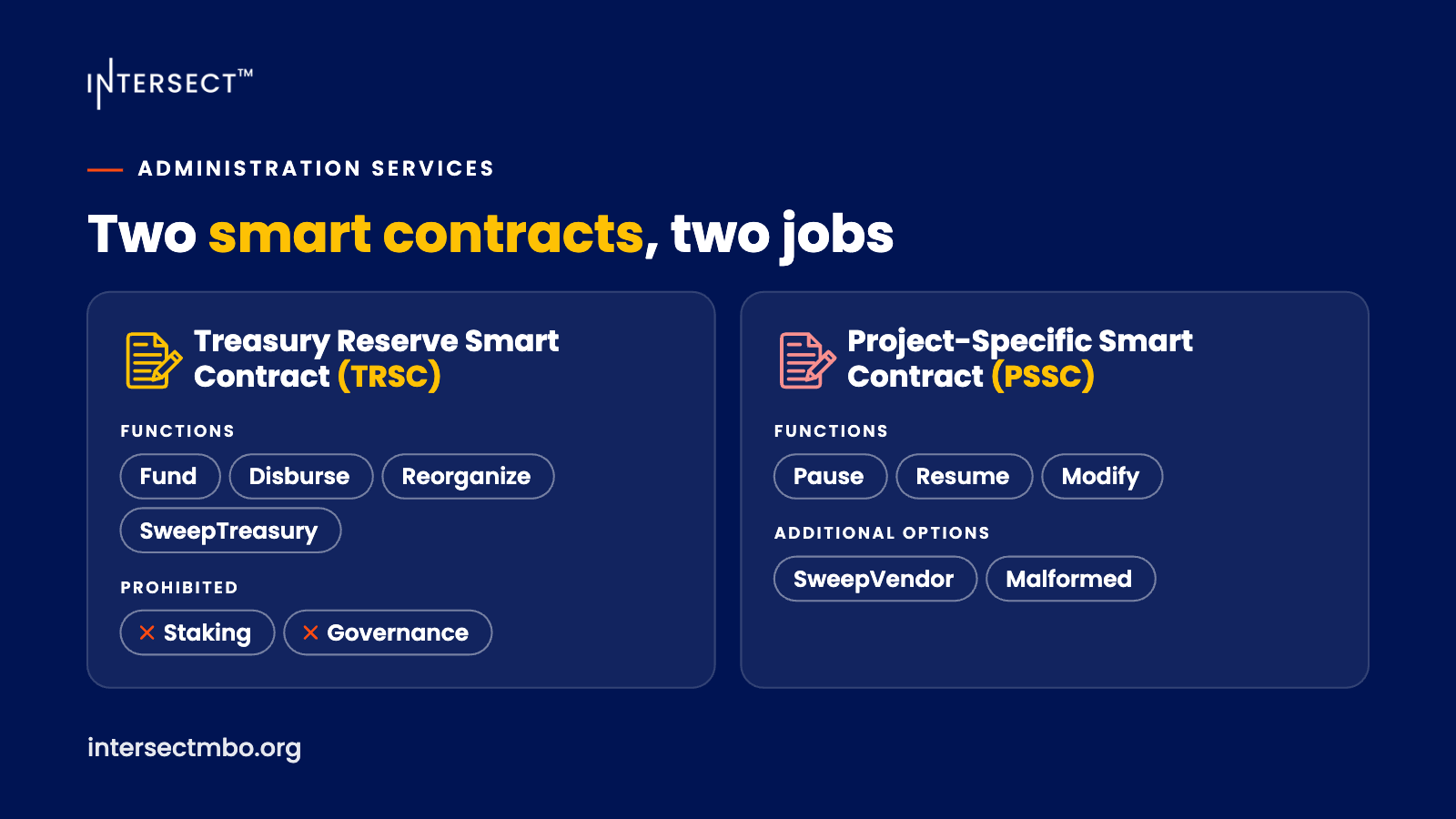
Intersect uses two types of smart contract in its role as budget administrator, Treasury Reserve Smart Contract (TRSC) and Project-Specific Smart Contract (PSSC) - each with different functions and actions.
Explore these features in detail, view the GitHub repository, and find the smart contract audits completed by MLabs and TxPipe on the Administration Services Hub pages.

Connecting with the community
A portal* for checking Cardano’s numbers - by Adam Rusch
The Cardano Regulatory Evidence Portal is live at verifycardano.com, built by Intersect Board member Adam Rusch with support from Intersect and analysis from student researchers at the University of Illinois.
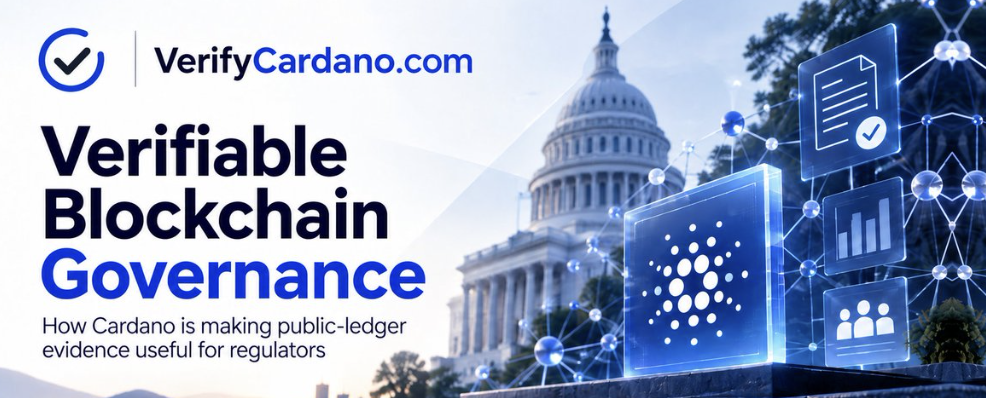
It publishes measurements of Cardano’s operational, economic and voting control, computed from public data under published methods and committed daily to the Cardano ledger. The portal removes the need to take any of it on faith: you can verify that a published measurement matches the record committed to the ledger, and where the historical inputs are available you can reproduce the calculation yourself using the published methodology.
*The portal is provided for informational purposes and does not constitute an official regulatory assessment or certification of Cardano’s operations or governance. All of it remains subject to the availability and limitations of the underlying data sources and methodologies.
Jack Briggs on Community influence and Cardano’s future - How do members turn ideas into action, and how do builders get funded?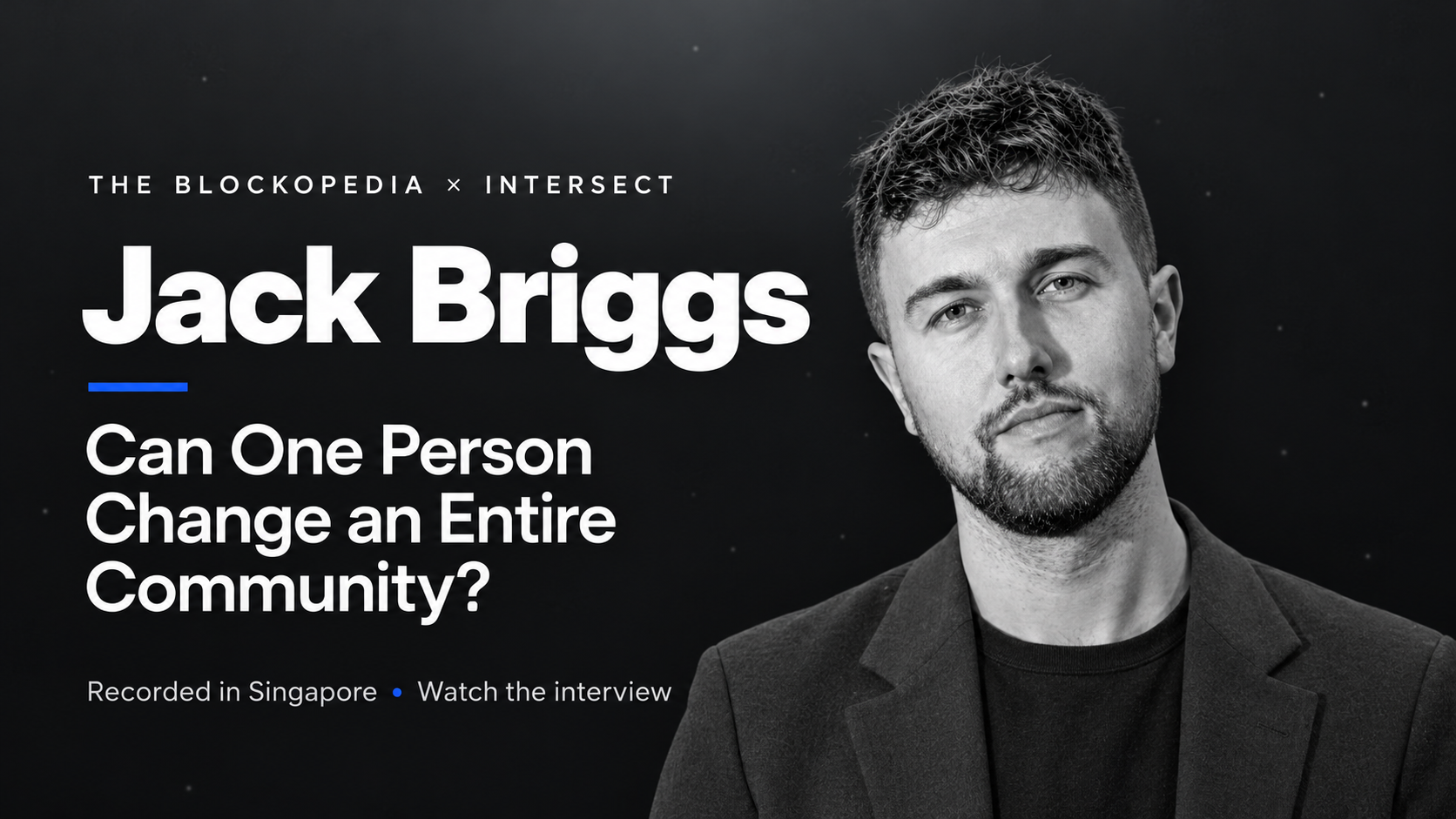
The first of Intersect Executive Director, Jack Briggs’ interviews recorded in Singapore is now live.
Speaking with The Blockopedia, Jack explored Intersect’s one-member, one-vote approach, funding for builders, and what lies ahead for AI agents and privacy.
You can watch the full “Can One Person Change an Entire Community?" interview on YouTube now.
And elsewhere this week, Cexplorer upgraded its mainnet explorer pages and CardanoScan added a real-time mempool tracker. DRepTalk added phone and tablet pairing. TxPipe shipped infrastructure patches.
The Cardano Foundation has been busy on two fronts. On education, an Agentic Coding on Cardano module has landed on Cardano Academy, alongside partnerships with UCLA and the University of Nicosia. On regulation, the Foundation has published a review of MiCA and a response on SEC classification.
Japan has been a steady thread for Cardano this month. The Midnight City event in Tokyo on October 10, NIGHT trading access through OKJ from October 13, and this week Charles Hoskinson addressing Japan’s N.Avenue club at its roundtable on protecting privacy in the AI era, where he argued that the future of finance combines the trust and liquidity of traditional finance with the speed and privacy of Web3. "The future will be decentralized."

Membership updates
Following the global PHP vulnerability news this week, the Intersect Members Area has been taken offline as a precautionary measure. While the Members Area itself is not impacted, some associated services may be and so the decision has been taken to place it into maintenance mode while our development teams continue to assess the ongoing situation and take any necessary steps before restoring functionality to the Members Area. There’s no action needed from members, no member data is affected, and we’ll confirm here and on our channels as soon as the Members Area is back.
We thank Intersect members for their patience in this matter.
What’s on next week:
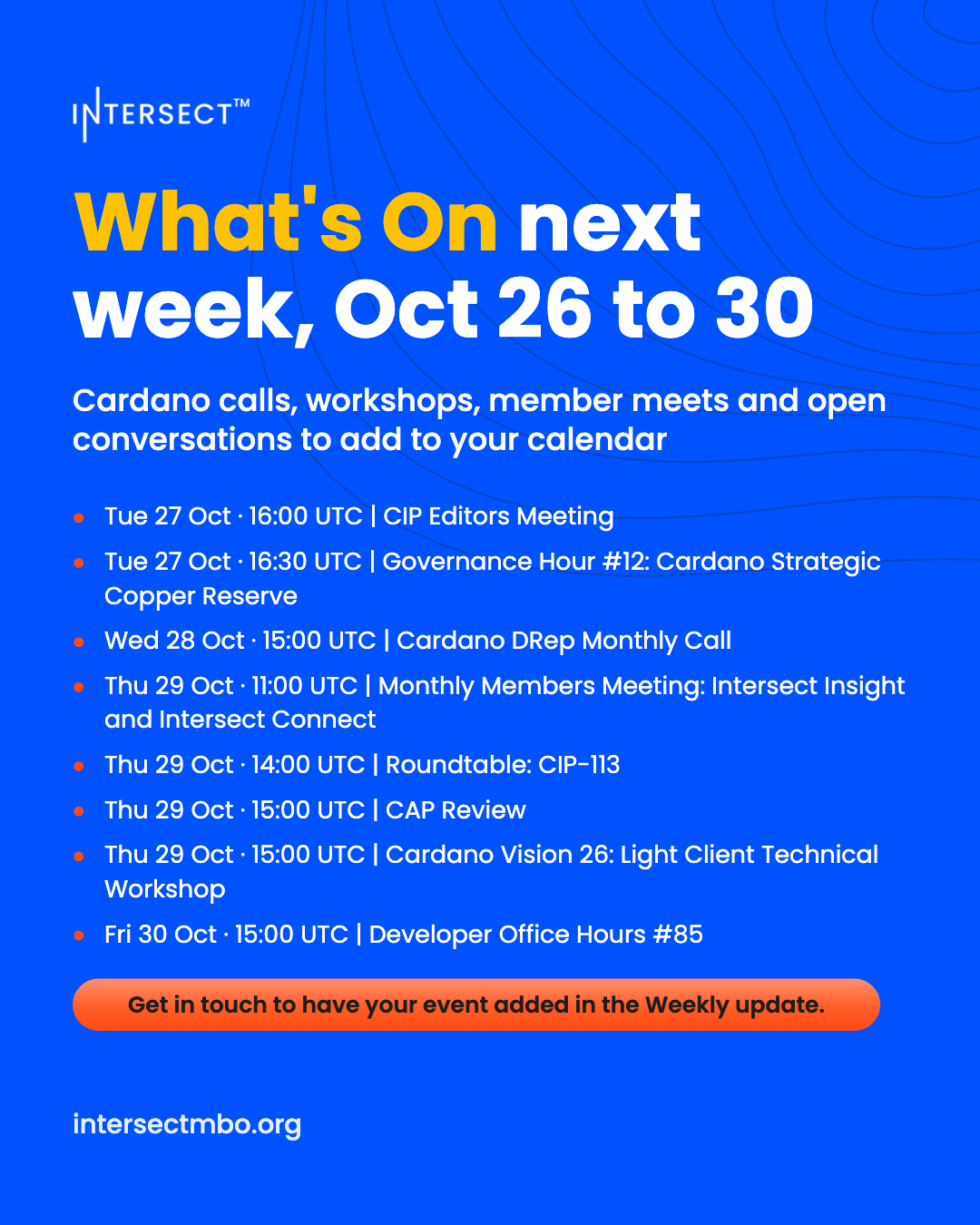
Tuesday 27 October
CIP Editors Meeting, 16:00 UTC. Open discussion to progress Cardano Improvement Proposals and technical standards, held on Discord. If the two funded editor roles we covered in #131 caught your eye, see what the work looks like here.
Governance Hour #12: Cardano Strategic Copper Reserve, 16:30 UTC. Nicolas Cerny joins Steven from Toto Finance to go through the ₳22M proposal, covering budget, custody, risks and intended treasury returns. The action is live on-chain until November 15, so this is a chance to hear it examined before you vote.
Wednesday 28 October
Cardano DRep Monthly Call, 15:00 UTC. Hosted by Tweag by Modus Create and Intersect on the last Wednesday of every month. Active governance actions, upcoming votes, treasury and budget discussion, and open Q&A.
Thursday 29 October
Monthly Members Meeting, 11:00 UTC. Intersect Insight brings updates from leadership and across Cardano. Straight afterwards, Intersect Connect heads to the Virtual Hub in our members area for something more relaxed: come and meet other members, ask what you have been meaning to ask, and have a look around if you have not been in. Livestreamed on X, with joining details announced there.
Roundtable: CIP-113, what programmable tokens mean for regulated assets, 14:00 UTC. Teams working on regulatory requirements discuss practical applications, what the standard simplifies, and where the gaps still are.
CAP Review, 15:00 UTC. The editors work through the live proposals in the open, including the fourth drafts of CAP-12 and CAP-3. Open to editors, authors and anyone following along, on Google Meet.
Cardano Vision 26: Light Client Technical Workshop, 15:00 UTC. Input Output Research on light client designs for Cardano, their security trade-offs, and the path to production-ready solutions.
Friday 30 October
Developer Office Hours #85: CIP-113, hands on, 15:00 UTC. CIP-113 launched at TOKEN2049. This is the session where you find out how to build with it. Giovanni Gargiulo, Senior Blockchain Architect at the Cardano Foundation, covers where the standard stands today, the architecture in five minutes, a tour of the code that already exists, and how to get started. Q&A at the end.
 That’s it for this week’s update. Thank you for reading. To learn more about Intersect’s work, explore the Knowledge Base, which provides detailed information on governance structures, committees, and funding.
Join the conversation on Discord, and follow us on Twitter (X) and LinkedIn to engage with fellow members, working groups, and the broader community. Subscribe to the public Google and Luma calendars.